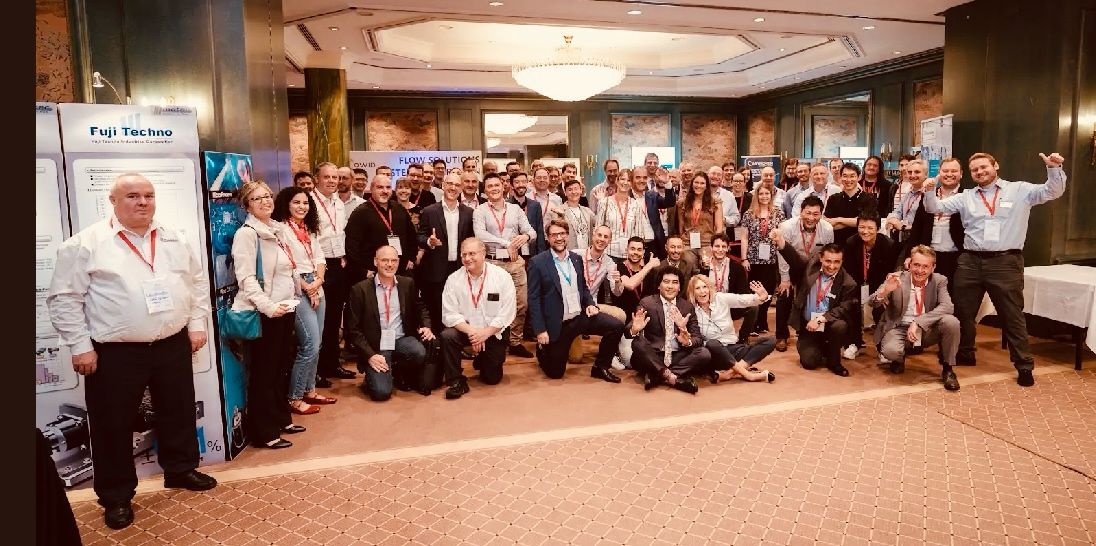

On September 17-19, 2024, the 15th CFRT for Industrial Applications Symposium took place in Wiesbaden, Germany. The event gathered experts from industry and academia to discuss the latest advancements in continuous flow reactor technologies.
Day 1 – September 17
Pre-Conference Workshops
The symposium began with two interactive workshops designed to provide hands-on experience with key technological innovations.
Sebastian Härtner, Process Development – Principal Project Lead, Merck Electronics, gave an enthusiastic keynote lecture about the status of Module Type Package (MTP) and how its use is changing the process industry. Key insight: the prerequisite is above all a rethinking of the way of how divisions work together.
Markus Arnold, Deputy Team Lead for Professional Services and Christof Franzke, Director of Life Sciences & Process Industry, COPA-DATA introduced Module Type Package (MTP) technology. Participants engaged in hands-on exercises using real-life equipment from Merck Electronics (group leader: Sebastian Härtner, Process Development – Principal Project Lead), Microinnova Engineering (group leader: Dirk Kirschneck, Strategic Director), and Fraunhofer IMM (groups leaders: -Michael Eberhardt, Hydrogen Technology Group, Fraunhofer IMM; André Pomraenke, Senior Engineer in the Group Digital Systems for Industrial Processes and Facilities- Fraunhofer IFF; Patrick Loeb, Deputy Head of Division Energy and Chemical Technology, Fraunhofer Institute for Microengineering and Microsystems IMM), gaining insight into modular automation and its potential for flexible chemical production. Key insight: MTP technology facilitates seamless process automation, allowing industries to quickly adapt to changing manufacturing needs.
Day 2 – September 18
Conference Sessions
The first full conference day started with a welcome address from Gayle De Maria, Senior Editorial Manager, Tks Publisher, Nima Yazdanpanah, Principal, Procegence, and Patrick Loeb, Deputy Head of Division Energy and Chemical Technology, Fraunhofer Institute for Microengineering and Microsystems IMM.
Keynote Address
Bernd Werner, Boehringer Ingelheim, present the success story of a telescoped four-step flow process including a final extraction and a subsequent batch conversion of highly energetic structures, the results, the drawbacks and the learnings they experienced within two pilot plant campaigns. Key insight: Successful implementation of flow chemistry requires overcoming process development hurdles such as clogging and material handling, but the rewards in terms of efficiency are substantial.
Morning Presentations
Dainis Kaldre, F. Hoffmann-La Roche, outlined the development of a continuous flow process for the manufacture of a key intermediate of the active pharmaceutical ingredient ipatasertib for the treatment of metastatic castration-resistant prostate cancer and triple-negative metastatic breast cancer. Key insight: Continuous flow Grignard reactions enable a high degree of process control, enhancing yield consistency and reducing operational risks.
Giuseppe Menin, COPA-DATA, introduced the advantages of a new approach based on MTP standard by giving concrete examples of the application of modular automation in the life sciences field. In particular, he showed how Merck Darmstadt in Germany is applying modular automation in the process development laboratories and pilot plants, discussed how Modular Automation can address Paperless operations, Tech Transfer and Flexibility and finally presented strategies for integrating modular automation into flow chemistry processes. Key insight: Digital integration and modular automation streamline production, ensuring enhanced operational flexibility and efficiency.
Jeff Derrick, Merck, introduced a scalable Claisen condensation process, enabling high-yield API manufacturing. Key insight: Multi-step continuous processes allow for improved throughput and reproducibility in pharmaceutical synthesis.
Lana Borukhova, Sanofi, discussed the benefits of combining batch and continuous processes in hybrid pharmaceutical manufacturing. Key insight: Hybrid approaches integrate the advantages of both batch and continuous processing, improving scalability and sustainability in API production.
Hendrik Held, Ehrfeld Mikrotechnik, and Thomas Kretschmar, Hitec Zang, highlighted the role of automation in flow chemistry, showcasing how reactor automation, online analytics, and optimization algorithms enhance process control and efficiency. Key insight: Automation enables precise, real-time process adjustments, leading to more reliable and scalable chemical manufacturing.
Afternoon Presentations
Matteo Baudino, Procos, presented the optimization and scale-up of ester reduction to aldehydes using continuous stirred-tank reactor (CSTR) technology under cryogenic conditions. The study involved extensive Design of Experiments (DOE) to fine-tune parameters like DIBAL-H equivalents, residence time, and temperature, successfully reducing impurity formation. The enthalpy of the reaction was also measured to ensure proper industrial setup. Key insight: CSTR technology enables safe, scalable, and highly selective ester-to-aldehyde reductions, overcoming the limitations of traditional batch processes.
Lukas Grahl, Semodia, and Sebastian Hartner, Merck Electronics, explored the four major challenges in the chemical and pharmaceutical industry: Time to Market, Quality, Costs, and Sustainability. The presentation demonstrated how Module Type Package (MTP) and Process Orchestration Layer (POL) technology can help address these challenges by improving process automation, digitalization, and system integration. They introduced the Marketplace by Semodia, a platform that connects engineers with process equipment manufacturers to streamline selection and implementation. Key insight: Leveraging ontologies and modular automation significantly enhances adaptability, efficiency, and competitiveness in chemical manufacturing.
Di Sha, Ou Shisheng, highlighted the use of microreactor technology for hazardous chemical reactions. Key insight: Microreactors provide improved reaction control, particularly for hazardous or highly exothermic processes.
Simon Coleman, AWL, explored the benefits of modular type packages (MTP) in continuous API development. By integrating flexible and configurable unit operation modules, MTP enhances scalability and efficiency.
Case studies highlighted its application in rapid API process development, demonstrating a significant reduction in time and resources required for experimentation. Key insight: Modular type packages streamline API development, reducing laboratory time while enabling seamless scale-up from research to production.
Fireside Chat
The conference concluded with a panel discussion on digitalization in pharmaceutical manufacturing, featuring Nima Yazdanpanah, Procegence, Howard Stamato, Stamato Solutions, and Sebastian Hartner, Merck Electronics. Key insight: The integration of AI, machine learning, and automation is revolutionizing pharmaceutical production, enabling smarter decision-making and enhanced quality control.
The event continued with the usual networking event at the restaurant of the 5 stars hotel exchanging ideas and talking about the future of the Flow chemistry community.
Day 3 – September 19
Conference Sessions
Keynote Address
The final day started with a keynote from Nima Yazdanpanah, Procegence, on System Dynamics, RTD, and Control Strategy Development.
He explored the intricacies of system dynamics in continuous manufacturing, highlighting the importance of residence time distribution (RTD) in maintaining process control. He presented an industrial-scale continuous drug substance manufacturing platform featuring two PFRs, one CSTR, and a surge tank, demonstrating how sensitivity analysis, RTD modeling, and control strategies can mitigate disturbances and optimize product quality. Key insight: Understanding system dynamics and RTD is crucial for ensuring process stability, designing robust control strategies, and meeting regulatory requirements for continuous manufacturing.
Morning Presentations
Laurent Vanoye, Laboratoire CP2M Catalyse, demonstrated scalable hydrogenation techniques using milli-structured reactors. Key insight: Milli-structured reactors offer improved safety, better thermal management, and higher selectivity in hydrogenation reactions.
Wen-Chun Zhang, Asymchem, explored how continuous flow technology is being integrated with enzymatic biotransformation and advanced pharmaceutical material science. Asymchem demonstrated its expertise in enzyme immobilization within flow systems, achieving significant scalability from gram to metric ton production under cGMP conditions. Several case studies illustrated how immobilized enzymatic processes enhance efficiency, sustainability, and process control in pharmaceutical manufacturing. Key insight: The integration of biocatalysis and flow chemistry is paving the way for greener, more sustainable pharmaceutical production.
Larry Yuanxian Wang, PharmaBlock, presented micropacked bed reactor applications for metric-ton scale API production. Key insight: Micropacked bed reactors enhance reaction efficiency while reducing energy consumption and waste.
Torsten Stelzer, MIT, showcased continuous crystallization techniques for integrated API manufacturing. Key insight: Combining continuous synthesis and crystallization optimizes product purity and process efficiency.
Afternoon Presentations
Eric Trzeciak, Tacmina Corporation, discussed pump technology innovations for precise flow control. Key insight: Advanced pump technologies enable precise reagent delivery, improving process stability.
Eva Deitmann and Gabriele Menges-Flanagan, Fraunhofer IMM, examined continuous organometallic synthesis for improved selectivity and safety. Key insight: Continuous organometallic processes ensure better control over reactivity and enhance workplace safety.
Federico Casanova, Magritek, demonstrated real-time reaction monitoring using benchtop NMR spectroscopy. Key insight: Inline NMR spectroscopy significantly reduces reaction development time by offering real-time analytical feedback.
Alexander Peschl, Peschl Ultraviolet, shared practical insights on the implementation of explosion-proof LED lamps in photoreactors. Key insight: Optimized thermal management and compliance with safety standards are critical for enhancing efficiency and durability in industrial photoreactors.
Guillaume Gauron, Corning, explored how continuous flow chemistry enhances safety in energetic materials production. Key insight: Continuous processing mitigates risks in hazardous reactions like nitration, improving overall safety and efficiency.
Linden Schrecker, SOLVE Chemistry, discussed the use of transient flow techniques to improve sustainability in process development.
Key insight: Advanced transient flow methodologies provide valuable data for optimizing reaction kinetics, selectivity, and solvent replacement.
Closing Remarks
The event concluded with reflections from the chairpersons and Tks Publisher staff, emphasizing CFRT’s role in fostering industry collaboration and innovation. CFRT reaffirmed its position as a premier platform for discussing continuous flow reactor technologies, bringing together experts to drive sustainable and efficient advancements in chemical manufacturing.
Participants were invited to join the CFRT community for the 16th Symposium in 2025 which will take place in Prague on September 24-25.
For more information please visit
www.cfrt-tks.com
Come and join the CFRT community!