
Introduction
Pharmaceutical, Biotech, and MedTech companies operate globally with complex portfolios and diverse production technologies. This diversity often comes along with fragmented local processes, siloed IT systems, and inconsistent understandings of global quality standard operating procedures (SOPs). While local optimization can improve efficiency and mitigate local deviations, it undermines transfers, synergy gains and digital transformation. In addition, it increases the risks of regulatory incompliance due to different interpretations.
Harmonizing processes across sites addresses these challenges. Local sites often see harmonization as a loss of flexibility – yet, when designed collaboratively, it can reduce workload. Global standards enable consistent regulatory compliance, enable knowledge exchange, drive joined learnings, reduce IT complexity, and establish a baseline for global analytics and AI tools. Yet, harmonization is not only a technical endeavor; without organizational change management and local involvement, it cannot succeed.
This article examines the dual nature of process harmonization: as a technological foundation for digital transformation and as an organizational journey.
Why Harmonization Matters
Quality and Compliance
In highly regulated industries, harmonization turns compliance from a local effort into a sustainable corporate capability. Global Standard Operating Procedures (SOPs) often set the framework, but they must be translated into executable and verifiable actions. Digital execution systems (e.g. for the production in Manufacturing Execution Systems (MES)) make this possible: they convert broad requirements into clear, step-by-step workflows and ensure that every site applies the same definitions for parameters, limits, and approvals.
However, harmonization does not mean uniformity at all costs. Local regulatory expectations and product-specific nuances must be reflected through a transparent change-control process. When global standards define what must be consistent and where adaptation is permitted, compliance becomes both robust and workable. With concrete implementations of processes and process variants in the digital solution such as MES, process adherence and compliance evolve from being documentation-driven to being digitally embedded in daily operations.
Example – Global SOP on Material Handling
A global SOP may require that “all raw materials must be verified prior to batch start.” On its own, such a statement leaves room for local variation. Within MES, the SOP is implemented in detail: the system enforces barcode scanning, checks expiry/retest date, batch assignment including release according to registration in the target country and thus prevents usage of not appropriate material. With a harmonized MBR it also defines exactly when all this is done.
Once compliance is embedded digitally, the next step is to leverage the same structures for efficiency and analytics.
The Foundation for Efficiency and Digital Transformation
Efficiency in global manufacturing does not arise from isolated local optimization but from shared structures and common understanding. Inconsistencies in performance data and cost are created even through small process variations—such as
– when the start of the production time is recorded,
– which actions belong to a changeover and determine the timeframe, or
– how material consumption is booked
Such differences across sites lead to limited transparency and causes issues for the global management and governance.
Harmonization establishes consistent rules and shared logic across the network. When all sites define time, material, and resource data in the same way, reporting becomes meaningful and resource planning predictable. Sites can compare performance objectively with other sites and identify where improvements truly add value. Transparency at the global level enables the organization to optimize the entire production network: supply chain planning becomes more accurate, sites that deliver efficiently and compliantly gain higher predictability in demand, and cost reliability toward customers improves. Considering the heterogeneity in specific process areas and portfolios of big companies it is recommended to cluster sites regarding their products, digital maturity level, legacy systems etc. This enables a focused harmonization of similar environments.
In addition to harmonize key process parameters, the standardization of master data—such as global MES Master Batch Record (MBR) templates, libraries, and process parameters—is highly beneficial. They allow faster onboarding, simplified training, and shorter validation cycles. Each new implementation builds on proven content, reducing both risk and effort. For local teams, this translates into faster implementations, less testing and fewer deviations.
Efficiency is only one dimension of this value. The same harmonized structures, such as MBRs, enable digital transformation at scale. A unified process and system landscape—covering execution, laboratory, and automation solutions—ensures that data flows seamlessly across domains. Execution systems (e.g., MES) guide operators through standardized workflows, laboratory solutions manage analytical depth, and automation layers deliver synchronized equipment data. Together, they create an integrated digital backbone.
With a consistent implementation, harmonization transforms data into a strategic asset. Performance trends (as a baseline for sharing best practices) and optimization scenarios become visible across the network, enabling faster and more confident decision-making. In the end, harmonization turns digital ambition into measurable, enterprise-wide maturity.
Organizational Enablement
Harmonization succeeds only when the organization around it is equally structured and engaged. Standards and systems (e.g., MES) can define how processes work, but people determine whether they work. Sustainable harmonization requires governance, community, and trust—three pillars that turn structure into culture.
Governance provides direction and accountability.
Global Process Owners (GPOs) define the standard process logic, approve changes, and ensure alignment with corporate objectives. Local Process Owners (LPOs) implement these standards locally, adapt them within defined boundaries, and collect feedback for continuous improvement. This feedback for sure need to be considered by the GPOs in a continued improvement cycle. Clear governance avoids both extremes: top-down rigidity and bottom-up divergence. It creates a controlled but flexible environment where global logic and local expertise complement each other.
Community creates ownership and shared intelligence.
A harmonization program thrives when it is co-developed rather than imposed. Communities of practice—composed of line managers, site engineers, Quality Assurance (QA) experts, planners, and IT leads—build the human network behind the digital one. They exchange learnings, challenge assumptions, and help translate abstract process models into practical routines. Many organizations formalize this through “blueprint boards” or regular design councils, ensuring that standards evolve through dialogue, not decree.
Trust and leadership make harmonization sustainable.
Sites must see tangible benefits: fewer deviations, faster approvals, simpler audits, and less duplicated work. Recognizing early adopters and sharing measurable results reinforce engagement. Equally important is allowing local flexibility where it adds value—harmonization should enable, not constrain. Leaders play a decisive role here: they set the tone for collaboration, balance global discipline with local reality, and protect the long-term vision from short-term pressures.
When governance sets structure, community builds connection, and leadership earns trust, harmonization becomes more than a rollout—it becomes part of how the company operates. It embeds clarity and accountability into daily work, making standards resilient to turnover, reorganization, and new technologies. In doing so, the organization moves from managing change to mastering it.
Lessons Learned and How to Start
And now? Are you excited about the benefits, and you want to start? In this chapter you see the important factors to consider:
- Assess the Current State
Identify critical process areas (production times, material consumption, deviation management, cleaning, evaluation of InProcessControls (IPC)) and perform a SWOT on ownership and governance. Evaluate the heterogeneity of sites and cluster them in process areas in which the heterogeneity is an actual differentiator for process variants. - Engage Stakeholders Early
Involve operators, supervisors, QA, computer system validation (CSV) experts, and IT in blueprinting; co-creation prevents resistance and surfaces practical constraints early. - Pilot and Scale
Start with high-impact areas (e.g., packaging/MBR or IPC), produce a validated blueprint, and then scale. Treat the first successful implementation as the reference line. And for sure, integrate key aspects of the lessons learned into the preparation and execution of later implementations. - Establish Governance
Clarify global process ownership and data ownership roles. In addition ensure a consistent change process combined with the release of budget as well as availability of global resources for the local alignments and reviews. - Invest in Change Management
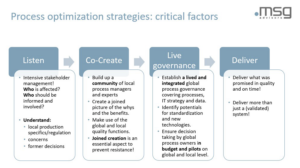
Provide transparency about the why, target state and path forward. Develop user stories, information material and trainings targeted to specific user groups. Ensure that concerns are heard and taken seriously. Identify change sponsors and ambassadors and give them the means to support people in the transformation. - Safeguards against erosion:
No local overrides without global approval; periodic audits for process adherence/template drift. - Harmonization before or alongside IT:
While many organizations harmonize during system projects, aligning process logic before rollouts demonstrably reduces complexity, accelerates deployment, and avoids costly rework. Where simultaneity is unavoidable, anchor the blueprint early and protect it through governance.
Start small, but design big: each pilot should already reflect the global logic.
Conclusion
Harmonization is not a technical clean-up exercise—it is a strategic capability that connects people, processes, and technology. It builds the foundation for efficiency, transparency, and resilience across the manufacturing network. When process definitions, data ownership, and governance models are aligned, every site operates with the same clarity of purpose while retaining local accountability.
Through this alignment, organizations gain the visibility to manage their global production network as one integrated system.
Performance data becomes comparable, supply chain planning more reliable, and customer cost expectations more predictable. Sites that deliver efficiently and compliantly gain visibility and trust—turning operational excellence into an internal competitive advantage.
Yet harmonization is, above all, a journey of organizational change. Sustainable adoption depends on how well people understand the “why” behind global standards, how early they are involved in shaping them, and how confidently they can work within them. Successful programs invest in structured change management: they listen before prescribing, explain before enforcing, and measure adoption as carefully as performance. By doing so, they create commitment rather than compliance.
Technology—such as digital execution systems (e.g., MES, Laboratory Information Management Systems (LIMS), and automation layers) —provides the backbone that makes harmonization executable. Governance and community make it sustainable. But it is leadership and change management that make it human: guiding teams through uncertainty, ensuring that harmonization empowers rather than overwhelms.
Ultimately, harmonization transforms standardization into a living capability. It provides structure without rigidity, fosters collaboration instead of resistance, and enables continuous innovation built on shared understanding. Organizations that align process, data, and people don’t just adapt to digital transformation—they lead it.