ADRIANO INDOLESE
Global Head of Development & Innovation
CordenPharma International – Member of Chemistry Today – Chimica Oggi Scientific Advisory board
THE KEYS TO ADDRESSING PHARMA SUPPLY CHAIN CHALLENGES – ESG, DIVERSIFICATION & GLOBAL HARMONIZATION
Since 2022, the global population of > 8 billion human beings have been consuming our natural renewal resources faster and faster, currently at a rate which is twice as much as our planet generates per year. Even commodities such as steel and wood are becoming scarce, as different industries and countries compete for the limited supply. We are also now experiencing the dramatic and often fatal effects of global warming on all continents.
Over the past 30 years, although the global economy has proven that collaboration and innovative technology can solve many problems, as was in the case of Hydrochlorofluorocarbons (HCFCs) becoming a greener alternative to the damaging effects of CFCs, the recent pandemic demonstrated how quickly those improvements can be undermined due to supply chain disruptions such as lock downs, transportation restrictions, and political conflicts. Through this process we have been forced to shine a collective light on the economic responsibilities connecting global warming, the need to consume fewer resources, and shifting supply chains.
Since all these events profoundly affect the pharmaceutical industry as well, we asked 23 CDMO panelists what they consider to be the greatest challenges in maintaining Pharma supply chain continuity. Among the responses, we identified common themes such as the increasing requirements for sustainability, the need for diversification of suppliers and regions, and the additional costs associated with them both as the major fields to be addressed for the Pharma supply chain of the future.
ENVIRONMENTAL, SOCIAL & CORPORATE GOVERNANCE (ESG) REQUIREMENT
The globalization of the world economy has made it very transparent that we all live on the same planet, where environmental pollution and global warming do not stop at national borders. Therefore, governments worldwide have implemented high standards for Environmental, Social, and corporate Governance (ESG) across all industries, including Pharma. Big Pharma companies expect that all companies in the supply chain adhere to the same principles, including their CDMO suppliers. As a result, Europe and the United States initiated several legislative activities from the Task Force on Climate-related Financial Disclosures (TCFD) and the Modern Slavery Act to the incoming US SEC Climate-Risk Disclosures rules.
Ingrid Vande Velde from PCSI points out that investors prefer companies that comply with ESG standards, since non-compliance can represent serious long-term business risks. However, all countries and companies involved in the global pharmaceutical industry should harmonize and develop these standards jointly. Otherwise, economics might drive pharmaceutical production to countries with laxer regulation and control by the authorities, as Paolo Tubertini from Olon Group comments, leading to further concentration of the production capacities in certain regions with lower standards.
Many panelists see the reduction of their carbon footprint as one of the major aspects of ESG. Most CDMOs have already joined an existing initiative such as Science-Based Targets initiative (SBTi) or EcoVadis. Some companies are developing their own programs. In general, ESG initiatives occur on different levels: 1) They start with energy efficiency projects in the existing plants to reduce energy consumption; 2) They switch to renewable energy sources by installing, for example, photovoltaic panels at the sites; 3) They explore and implement new, more energy-efficient technologies such as Flow Chemistry; and 4) They work with their suppliers to reduce the carbon footprint of the incoming goods.
The first two activities can be implemented quickly with limited investment and clear payback times. The latter two are more challenging, as they also affect the regulatory filing that increases cost and timelines. Many panelists mention the different requirements of the authorities for regulatory changes as a real obstacle for the fast implementation of improved processes or new starting materials. Specifically, greater regulatory scrutiny increases the hurdles for new material qualification, as Stefan Randl of Evonik points out. Herve Bedrou, from Piramal Pharma Solutions, hopes that the regulatory systems can be globally harmonized, leading to convergent international standards and mutual acceptance of data for regulatory filing.
To enforce the new ESG standards, the need for audits will increase. However, since some companies say they are already at the limit of hosting customer and authority audits, Jim Fries of Rx-360 proposes going for joint audits or licensing audit reports by globally accepted auditing companies.
DIVERSIFICATION OF SUPPLIERS & REGIONS
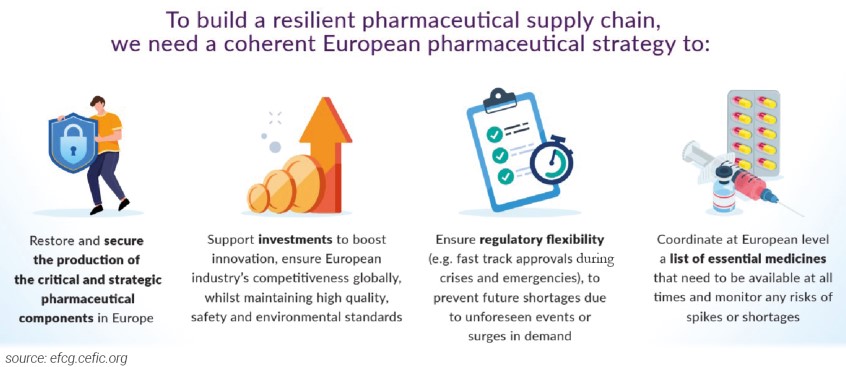
In the past few years, we saw different events that disrupted the pharmaceutical supply chain in unprecedented ways – shutdowns of facilities in China due to environmental problems, the blockage of the Suez channel, Covid-19, and the war in the Ukraine were completely unpredictable factors affecting the pharmaceutical industry as a whole. They not only led to problems and delays in pharmaceutical production, but also shortages of crucial, life-saving medicines, where some countries went so far as to restrict the export of medicines, which only compounded the situation. It’s safe to say we all hope governments will prepare better for such events in the future through closer collaboration and more sound science-based decision making, which takes into account that pandemics and the expected effects of global warming such as flooding, storms, and droughts will occur more often.
Many companies act now by applying a multitude of approaches, depending on their expertise and position in the market. This includes diversifying their supplier region, stocking of critical raw materials, and identifying alternate reagent sources, as Michael W. Pennington of AmbioPharm comments. Procos (Chiara Rigotti and Paolo Paisoni) focuses on developing close relationships with carefully chosen preferred suppliers and having several backups for key raw materials in different regions.
Ed Roullard from Actylis, points out that a proper risk mitigation and thorough analysis of the supply chain is key for success. The back-up supply chain must be truly independent, and must not go back to the same intermediate suppliers.
Some companies like Uquita India (Kishore Reddy) consider backward integration and using closer suppliers as a good strategy to make the supply chain more resilient.
Anming Liu, WuXi STA, explains that insourcing could be an opportunity to open new business fields, such as WuXi STA did by developing its own amidite manufacturing capability for their oligo customers, which resulted in them now offering more than 300 types of catalog amidite products to the market.
Europe noticed the painful dependency on India and China for certain medicines during the Covid pandemic. Several panelists mentioned the governmental tender systems in Europe and the US with the sole focus on price as one cause for the concentration of the generics in India and China.
Many countries announced aims to strengthen their pharmaceutical industry, and Chris Neasham, Almac science, thinks that the manufacturing is shifting back to the west. France, for instance, initiated large programs. However, Elizabeth Stampa, President of Medicines for Europe, noticed that beyond these big announcements, so far the initiatives only received minimum support in most European countries. We will see if the European governments have a sincere and sustainable intention to support more robust and diversified pharma supply chains, and to also consider other aspects such as such as sustainability and supply chain security in their public tender systems for medicinal products.
Several panelists, including Matthieu Gobillot, Seqens, expect that India’s chemical industry will benefit from the situation, as there is a clear support by the government and a large pool of exquisite talents. However, Chiara Rigotti and Paolo Paisoni, of Procos point out that China will remain more competitive for certain raw materials, due to their lower environmental standards. Both India and China remain big players in the pharmaceutical industry.
INCREASING COSTS & INFLATION
Due to the financial pressures during Covid, coupled with increased energy prices, we now observe a worldwide inflation, which is very pronounced in the EU. Actions to mitigate the supply chain risk and implement ESG principles also increase the production cost in the long-term. Stefan Randl, Evonik Health Care, thinks that the backward integration of regulatory starting materials helps to stay competitive, while ensuring quality and supply security. Dr. Shijie Zhang, Dr. Jack Chen, and Celine Chen say Pharmablock is focusing on upgrading their chemistry – e.g. flow chemistry, micro-packed bad hydrogenation and bio catalysis – in order to reduce carbon footprint, while keeping the cost low.
Kenneth N. Drew, Flamma, comments that for generics, it is very difficult to transfer the additional cost from supply chain disruptions to customers, as in many cases the prices were negotiated before the crisis for very long-term contracts. Andrea Sentimenti of Bormioli points out that where the margins were low before inflation, the increase of energy and raw material cost has caused a dramatic erosion of margins for the generic market. Therefore, authorities should transform the system of public tenders so that buying decisions are not only made on price, but also consider supply security, social and environmental impacts (Ana Marti, Medichem).
Since innovative pharmaceutical companies are more open to accepting higher prices, the chances are better that a part of the inflation and ESG costs will be jointly covered by the CDMOs and their customers. Nevertheless, CDMOs remain under strong pressure to reduce cost and optimize their supply chain.
CONCLUSION
The Pharma industry faces big challenges, not the least of which is that we compete with different industries for the same limited resources. We must fight global warming and deal with its effect, all this in uncertain geo-political situations. As paradigms shift, we probably all agree with Timothy Woodcock of CordenPharma that “the biggest challenge is to adapt our mindset – the way we think and what we will accept – in Supply Chains of tomorrow.”
– Pharmaceutical companies apply different approaches to cope with the future challenges – including Artificial Intelligence and block chain technology – that can help to make the supply chain more predictable and resilient.
– Changing production processes are currently a lengthy and costly endeavour due to the filing of the regulatory changes to different authorities. The health care authorities could further support the transformation of the industry by implementing globally-harmonized procedures for changes and mutually accepted data.
Governments play the most decisive role in the transformation of the Pharma industry, as they can set the proper incentives by implementing the appropriate legislation. These incentives should reward companies that have implemented measures for environmental protection and CO2 reduction, as well as high ethical standards. The legislation must be globally harmonized; otherwise, companies complying with the higher ethical and environmental standards will be at a continual disadvantage against those that do not have obey the same strict standards. Here, it is crucial that governments and authorities demonstrate their willingness to collaborate openly and peacefully to solve the problems which not only affect the supply of life-saving medications for patients, but also the future of our global community and planet.